Course objective
This course aims to familiarize participants with multiple and market-based valuation techniques essential for equity valuation. The course covers the theoretical foundations, practical application, and contextual limitations of using valuation multiples and market data to estimate firm value. Through a combination of lectures, data exercises, and case studies, participants will develop the ability to select appropriate peer companies, compute and interpret valuation multiples, and integrate macroeconomic considerations. The course also encourages collaborative problem-solving and critical analysis of valuation outcomes to enhance decision-making skills.
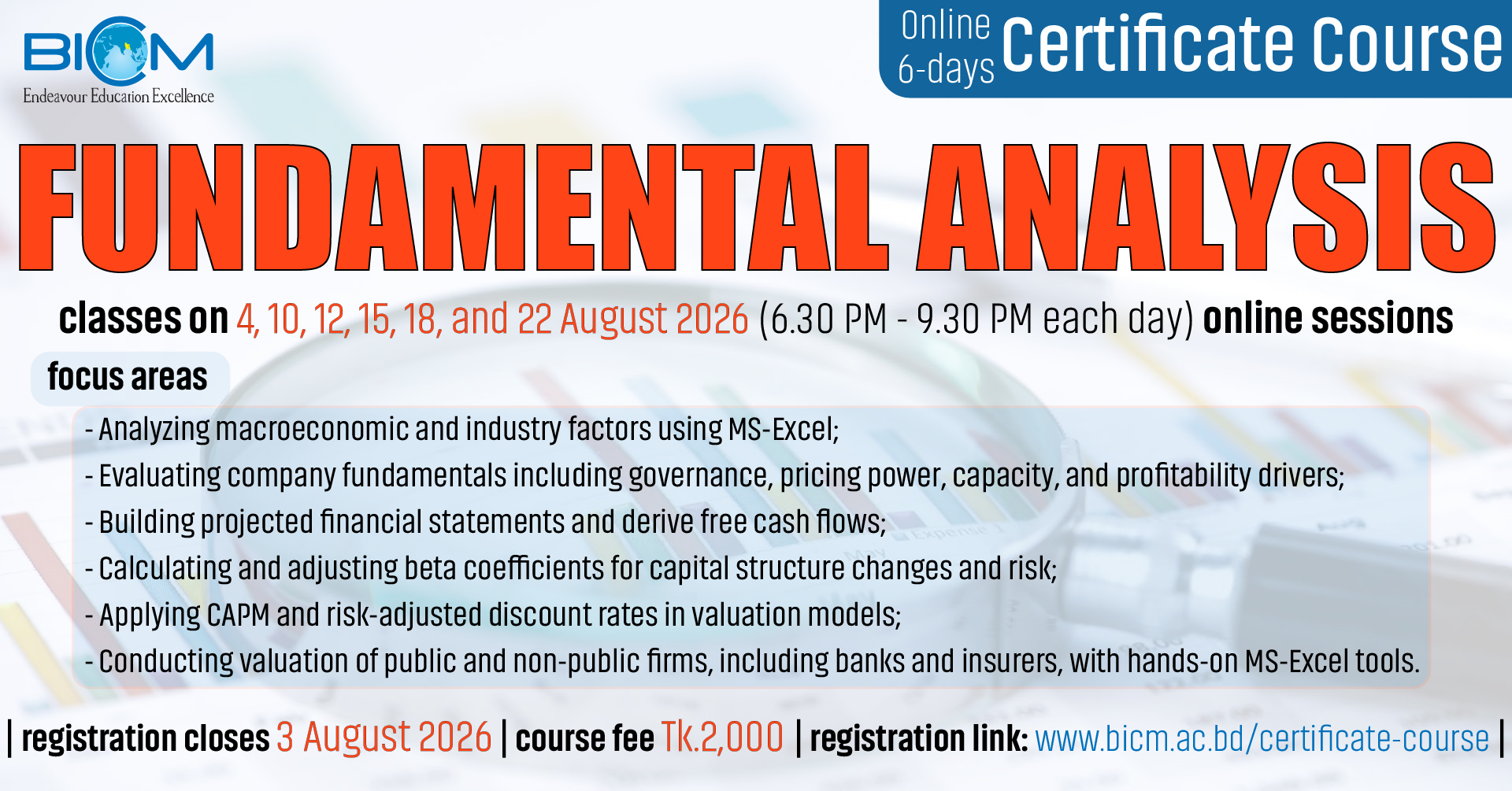
Participants will learn about advanced valuation techniques focused on discounted cash flow (DCF) analysis, enhanced by real options and risk adjustments. Participants will also learn to evaluate the macroeconomic and industry drivers impacting equity value and apply Excel-based tools to analyze market structure, competitive forces, and company fundamentals. The course delves into comprehensive company analysis using governance, revenue drivers, profitability, and cost behavior. Participants will build integrated projected financial statements, calculate free cash flows (FCFF and FCFE), and estimate risk-adjusted discount rates using CAPM and beta adjustments. The course also introduces practical valuation scenarios for startups and real options, culminating in real-life analyst case studies covering public, private, and financial institutions.
Key takeaways
- Understand the core valuation approaches, with emphasis on market-based multiples.
- Gain hands-on experience in calculating and applying common valuation multiples (P/E, P/B, EV/EBITDA, etc.).
- Learn to identify comparable firms and adjust data for meaningful relative valuation.
- Appreciate the role of market efficiency and macroeconomic factors in valuation models.
- Conduct sensitivity analysis and interpret forward-looking multiples.
- Analyze industry-specific valuation nuances and challenges.
- Collaborate effectively on case studies and present valuation findings professionally.
- Analyze macroeconomic and industry factors using Excel (e.g., HHI, Porter’s 5 Forces, SWOT/PEST).
- Evaluate company fundamentals including governance, pricing power, capacity, and profitability drivers.
- Build projected financial statements and derive free cash flows (indirect method, IAS-7).
- Calculate and adjust beta coefficients for capital structure changes and risk.
- Apply CAPM and risk-adjusted discount rates in valuation models.
- Incorporate real options and zero-based budgeting for startup valuation.
- Conduct valuation of public and non-public firms, including banks and insurers, with hands-on Excel tools.
- Interpret valuation narratives and reconcile quantitative outputs with qualitative insights.
Topic 1: Introduction to valuation approaches: income, asset, market-based - Importance and context of market-based valuation - Overview of key multiples: P/E, P/B, P/S, EV/EBITDA, EV/Revenue - Market efficiency concepts and macroeconomic influences - Data collection: accessing and extracting market multiples from Bloomberg, Reuters, financial reports
Theory and practical access to market data, Extracting and understanding multiples for a sample company
Topic 2: Selecting comparable peer firms: criteria and challenges - Calculating and adjusting valuation multiples - Stepwise relative valuation process - Common pitfalls and solutions - Group case study: valuation using multiples and discussion
Peer selection techniques, Hands-on multiple calculations, Collaborative valuation exercise and findings comparison
Topic 3: Forward vs trailing multiples, adjusted multiples (PEG, EV/EBITDAR) - Integrating macroeconomic factors: interest rates, inflation, economic cycles - Sensitivity analysis in valuation - Industry-specific valuation comparisons - Group project presentations and feedback
Advanced multiple concepts, Macroeconomic impact and scenario testing, Presentation of group valuation projects with peer/instructor critique
Topic 4: Industry significance in macroeconomy - Stock selection within industry - Economic Moat analysis in Excel - Herfindahl-Hirschman Index (HHI) - Market growth & incremental share forecasting - Porter’s Five Forces model - Industry risk assessment - SWOT & PEST analysis
Use Excel for concentration and competition metrics, Analyze industry risks and competitive dynamics, Forecast market share and growth opportunities
Topic 5: Corporate governance scorecard in Excel - Revenue and production drivers - Capacity utilization and pricing power - Direct product profitability (DPP) - Pareto analysis - Cost drivers and key ratios - Horizontal & vertical analysis - Growth, reinvestment, and ROIC analysis
Hands-on Excel work on revenue & cost forecasting, evaluate profitability and efficiency metrics, Analyze growth drivers and reinvestment needs
Topic 6: Projected financial statements - Free Cash Flow estimation (FCFF & FCFE) - Beta calculation, CAPM, and risk-adjusted CAPM - Gearing and ungearing beta - Discount rate and terminal growth rate estimation - Enterprise and equity value calculation - Zero-based budgeting and real options - VC valuation model example
Build integrated valuation models in Excel, Adjust for risk and capital structure, Model real options and startup valuation techniques
Topic 7: Practical DCF valuation walkthrough - Publicly traded company valuation in Excel - Non-public company valuation - Valuation of banks and insurance companies
Apply learned methods to real companies, Address sector-specific valuation issues, Clarify doubts and consolidate learning