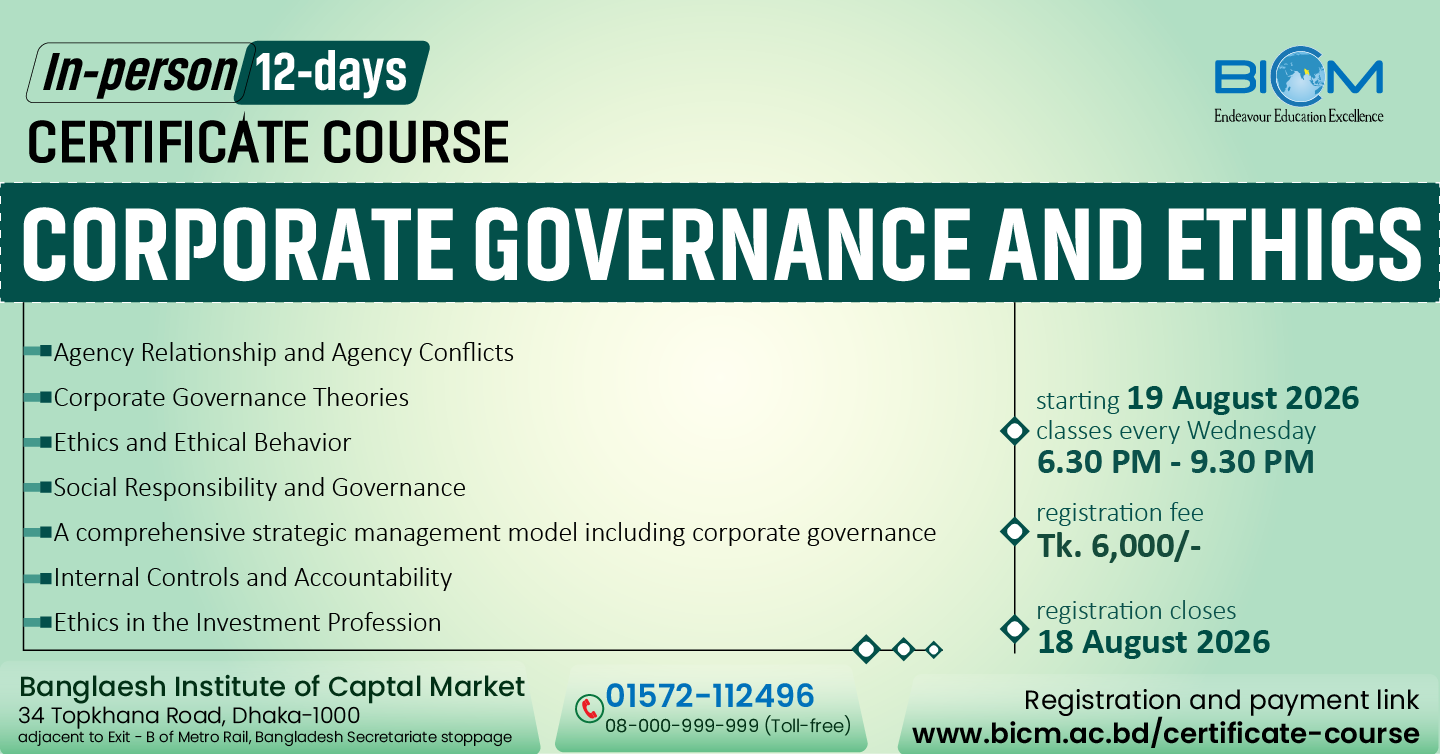
Corporate governance deals with complex set of relationship between principal – agent (PA). So, corporate governance tries to solve two PA problems, which are present in large corporations where ownership of residual cash flow and control are in different hands. One such PA problem arises between the owners of capital and managers, and another between the small, dispersed owners and large, concentrated blockholders of the firm. The objective of the course is to present the main questions and answers related to corporate governance, the theories describing them and the empirical work.
The course will discuss different theories of corporate governance, conflict of interest among stakeholders, a comprehensive strategic management model including corporate governance, internal analysis and strategic capability, the value chain etc. It will also explore the role of board of directors, code of ethics and standards of professional conduct and importance of ethics in the investment profession.
Upon successful completion of the course, participants will be able to:
🎓Critically apply corporate governance theories and frameworks to the different corporate governance structures;
🎓Identify causes and consequences of agency problems due to inherent conflicts of interest between different stakeholders;
🎓Demonstrate an advanced understanding of the role of the board of directors in shaping the strategy of a company and protecting the interests of stakeholders;
🎓Acquire the skills of matching corporate governance decision and a company’s strategy, alongside taking ethical and reasonable, data-driven CG decisions.
Course Contents:
🖋️Agency Relationship and Agency Conflicts: Stakeholders and Corporate Performance, Development of corporate governance as an issue: Historical background and recent questions, Stakeholder and Corporate Performance, Stakeholders and the Enterprise, Stakeholder Impact Analysis, The Unique Role of Stockholders, The Challenge for Principals, Governance Mechanisms, Governance Mechanisms Inside a Company, A Balanced Scorecard Approach, Ethics and Strategy, Ethical Issues in Strategy, The Roots of Unethical Behavior, Philosophical Approaches to Ethics
🖋️Corporate Governance Theories
🖋️Ethics and Ethical Behavior: Values, Moral Reasoning Reasons for various ethical practices, Cultural Relativism, Checklist for dealing with ethical dilemmas, Rationalizing Unethical Behavior, Ethics Training, Whistleblowers
🖋️Social Responsibility and Governance: Organizational environments and social responsibility; general environment and specific environment; social responsibility, the case in favor of social responsibility and against social responsibility; strategies; immoral, moral and amoral manager; ethics mindfulness
🖋️Board Room review, role of Board of Directors, types of Board of Directors and their responsibilities
🖋️Audit committee & its role, functions and so on
🖋️Principles of Good Corporate Governance: Stakeholder Analysis & Five Golden Rules, Reporting System, Corporate Governance and the Strategic Management Process, the whole picture, strategy analysis aligning perceptions & expectations
🖋️A comprehensive strategic management model including corporate governance, internal analysis, internal analysis and strategic capability, the value chain, the external analysis and competitive position, PEST analysis, stakeholder analysis, the stakeholder analysis process, weighting the stakeholders
🖋️Good Reporting: Basic features of good reporting system, a model for reporting system
🖋️Country Risk Analysis: Types of country risk assessment, macro-political risk, macro-financial risk, micro-political risk, micro-financial risk a checklist approach the Delphi technique, techniques of assessing country risk, developing a country risk rating
🖋️Internal Controls and Accountability: Internal control system, COSO’s framework, enterprise risk management. Deal and Kennedy: risk, feedback, and reward
🖋️Principle of Ethics and Standards
🖋️Code of Ethics and Standards of Professional Conduct
🖋️Developing Ethical Intelligence
🖋️Ethics in the Investment Profession